
Sometime in the coming days, weeks, or months, the Pentagon is expected to release its accounting of how the war in Afghanistan ended. A special review panel has read through millions of pages, and its chairman has promised the most thorough accounting the American people have received.
I am publishing this today, on purpose. Nobody outside the Pentagon knows when this report lands. It could be next week. It could be next year. What I do know is that tomorrow is five years since Abbey Gate, and tomorrow is not a day for arguments. Thirteen Americans and roughly 170 Afghans were killed at that gate, and the people who loved them are owed a day that belongs to them and not to Washington. So I am setting the standard now, while the document is still unwritten to the rest of us, and tomorrow I will be quiet.
I want accountability for August 2021. Thirteen Americans were killed at Abbey Gate. Hundreds of thousands of allies were left behind. The people who made those decisions should have to answer for them in public, with their names attached. No question.
What I do not want is another political document. We have had several of those already. Not one of them has moved a single Afghan ally out of harm’s way. And the last thing we need is more failed prosecutions of the President’s perceived enemies. They aren’t working and they don’t do a single bit of good for someone in need of actual help.
And here is the part Washington will not say out loud. Relitigating a disaster that every honest person already agrees was a disaster does not absolve the people currently in power of what they have done since. You cannot indict the last administration for abandoning our allies while your own is doing it on purpose.
President Joe Biden messed up the withdrawal. That is not a talking point. It is the truth, and I said so at the time, loudly, including directly to President Biden and his White House team.
President Biden’s people will also tell you it was the largest humanitarian airlift in history, and that it likely would not have happened under another president. They are right about that too. Both things are true at once, and anyone who can only hold one of them is doing politics, not accountability.
Then his administration did something rarer still. It sat down with veterans and civil society, with the people who had spent that August on phones trying to get families through the gates, and together we built Enduring Welcome. It carried tens of thousands of vetted allies to safety on the most heavily screened immigration program in American history, built on vetting the first Trump administration itself designed. The government’s own review of that population found 55 watchlist matches, 46 of them already cleared.
This administration shut it down anyway. Follow that logic to the end. President Donald Trump’s government looked at vetting built by President Donald Trump’s government and declared it insufficient.
That is what a real accountability report would have to reckon with. I doubt this one will.
We have been keeping our own accounting, and here is the standard I would hold any new one to. A report that stops in January 2025 is not an accounting. It is an alibi. Anything serious about how this war ended has to go further, and name the forces inside this government that stopped Enduring Welcome. Who decided? When? Why? On whose authority?
Which brings me to the two people who had a lot to say back in 2021 but I never hear discussed in this context anymore, both of whom can act today.
In August 2021, as the evacuation collapsed, a congressman named Markwayne Mullin went rogue, flew halfway around the world, and tried twice to get into Afghanistan to pull people out. It was unauthorized, reckless, and it got him crosswise with the State Department. It was also the act of a man who could not stand to watch his country break its word. He then became a Senator. In March, the Senate confirmed him as secretary of Homeland Security.
Mike Waltz earned his Green Beret tabs in Afghanistan and spent years in Congress hammering the way the war ended. He is now America’s ambassador to the United Nations. During and after the withdrawal, then-Congressman Waltz was one of the most vocal advocates for taking care of our allies.
Waltz did something else in those years that deserves saying plainly. He put the families of those thirteen Americans in front of the country, and he got them time with Donald Trump. He told the story himself from the Republican convention stage in 2024: the meeting had been scheduled for an hour, and Trump stayed six. In that same speech, Waltz said Biden “won’t even take their calls.”
He was right. President Biden’s handling of those families was shameful, and we said so to his administration at the time, directly. Whatever you think of the politics, what Waltz did was honorable, and I said that then too.
I also watched what came next. Through the 2024 campaign, Afghanistan came up every single day. At the convention, the families were brought onto the stage and all thirteen names were read aloud while the hall chanted. The withdrawal became the party’s most dependable applause line.
Then President Trump won, and the talking stopped.
On January 13, 2025 I sat next to Congressman Clay Higgins, who at the time chaired the Homeland Security Committee’s border security subcommittee, on a flight. He walked me through the executive orders that were coming. The next day AfghanEvac put together an open letter to the incoming president, the incoming vice president, and congressional leaders, laying out precisely which Afghans would get caught in the machinery and how to avoid it. Higgins asked me to follow up with him.
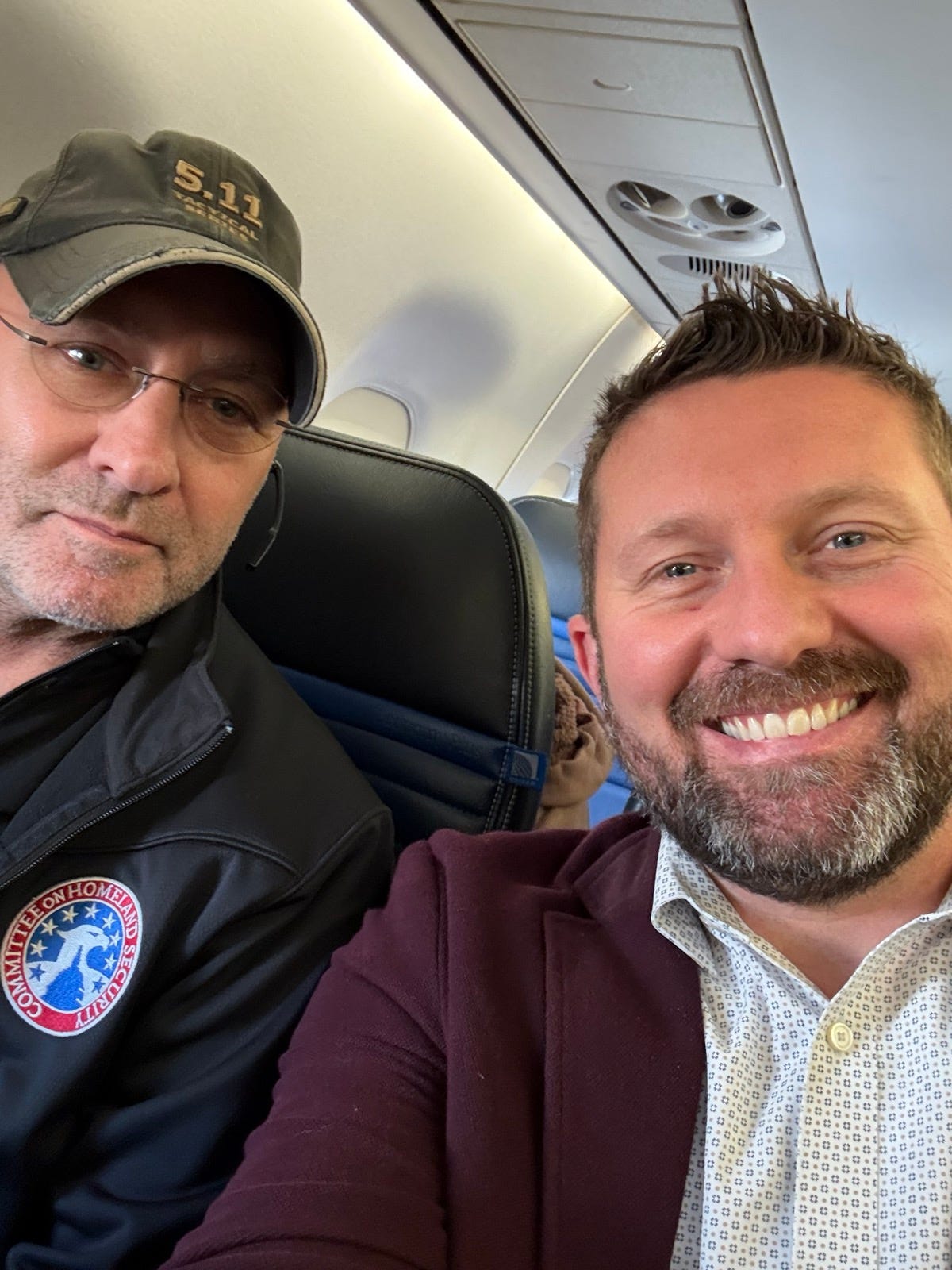
I followed up, multiple times. I never heard from him again. Ghosted.
That is where I take issue. Political people are going to do political things, and I have been at this long enough not to be shocked by it. But when you build an argument on a war and on the people who fought it, the least you owe them is that something good happens on the other side of the election. Afghanistan was worth mentioning every day when it cost their Democrats something. It has been worth mentioning almost never since it started requiring a signature or defense of their total deconstruction of the effort.
I do not believe a person’s moral clarity should change depending on who sits behind the Resolute Desk. That is exactly why the silence now is so hard to understand.
Between them they have the pen and the platform. Neither has used it. And it doesn’t matter what they’re doing in private because Afghan allies, and the veterans with whom they served, cannot see or hear that.
Here is what that costs. Roughly 3,000 Afghans still stranded in the pipeline are the immediate family of American service members. Not allies in the abstract. The parents, spouses, and children of people wearing the uniform today. About 150 of them are inside Camp As Sayliyah in Qatar, the State Department site the government said it would empty by March 31 and which still holds 1,039 people. A party that stakes its identity on standing with the troops is stranding the troops’ own families by choice.
In March 2022, six months after the last plane left Kabul, President Biden delivered a State of the Union that said nothing about the war he had just ended. His chief of staff, Ron Klain, had told me it would be in there. Then Russia attacked Ukraine, and none of the Afghanistan language survived the rewrite. I told Klain afterward that history would judge them harshly for walking away without closing it out. In the days that followed, more than two dozen people inside his own government called me, sick that the president had said nothing.
Biden’s post-withdrawal failure was not the program. He and his team, built the right one, Enduring Welcome. I know because our team was right there with them.
His failure was nerve. He would not talk about it, would not defend it in public, would not spend a dollar of political capital on it. So the most sustained act of wartime faith-keeping in generations sat there undefended, and the next administration killed it without breaking stride.
This administration’s failure is intent.
Over the past 18 months it has dismantled that promise piece by piece. It shut down Enduring Welcome, eliminated the office that ran Afghan relocation, and folded Afghanistan into a sweeping visa ban. It has issued one single visa to a principal applicant holding an Afghan passport since the first day of 2025. And it moved to strip Temporary Protected Status from Afghans already here, opening the door to deporting people to a country that would kill them.
Last week a federal judge vacated the 75-country visa freeze. My organization immediately had to warn Afghan families that the ruling does not by itself reopen the door, because there exists yet another ban in the form of Presidential Proclamation 10998. That is the whole problem. A court can strike down a policy but this administration has taken a layered approach to cutting off pathways, because they knew they would take some losses in the courts.
None of the damage required an act of Congress, which means undoing it does not either.
Start with the people already inside our borders. Temporary Protected Status is not a matter for the courts or a floor vote. It is a designation the secretary of Homeland Security makes with a signature. Secretary Mullin can keep tens of thousands of interpreters, pilots, and partners already living and working in American communities from being sent back to the Taliban. He can do it this week.
If he won’t do it, the bipartisan Afghanistan TPS Act is already moving in both chambers, carried in the House by two Republicans and two Democrats and in the Senate by Chris Coons and Lisa Murkowski. Congressional leadership could put it on the floor of both chambers in September.
Then take the camp, because that one is even simpler. The refugee suspension this administration signed in January 2025 was never absolute. Section 3(c) left an exception in it, and the exception is a joint determination: the secretary of State and the secretary of Homeland Security may together admit refugees case by case, in their discretion, whenever they find it is in the national interest. Secretary Mullin and Secretary Rubio could empty Camp As Sayliyah using authority this administration wrote for itself. No court. No Congress. Two signatures and a finding that keeping our word to the families of American troops serves the national interest.
Then there is everyone else, a quarter of a million people across some 90 countries, in Pakistan under threat of deportation and in hiding inside Afghanistan. No designation reaches them. They need the pipeline restarted and funded, which is what the Enduring Welcome Act would do. Secretary Mullin backed that effort as a senator and was preparing to help lead it. The man who now holds the pen once reached for it himself.
Waltz’s lane is different. As a former national security adviser he still has the president’s ear, and as ambassador he can press Islamabad and Doha to stop handing people back. At minimum, he can say the word Afghanistan out loud where our allies are running out of time and not just to take a shot at the former administration.
None of this should be hard. Republicans and Democrats have worked side by side on these allies for five years, including recently on the bipartisan ARCH Act to preserve the records that prove who these people are.
What is missing is not bipartisan will.
It is the nerve to cross Stephen Miller, whose restrictionist instinct has governed this White House’s approach to Afghans and produced nothing but harm. In deferring to him, this administration is squandering the goodwill Republicans spent two decades earning with veterans, frontline civilians, and military families.
So let the report come. Read it. Let it name names, and let the names include people I have worked with and defended. Then let it keep going, past the withdrawal, into the offices where the pipeline was switched off and left off.
But accountability is not a document about 2021. The House, Senate, Department of Defense, Department of Homeland Security, and State Department have already done those. It is what we do in the weeks we still have, while a camp in Qatar counts down and three thousand American military families wait to hear whether their country meant what it said.
I told Ron Klain that history would remember how we ended this war. It still will. What history will not care about is which administration held the pen when the pipeline went dark. It will ask who turned it back on.
We cannot say we honor the fallen in Afghanistan if we are unwilling to finish the job.
Secretary Mullin flew across the world for them once. He does not have to leave his office to do it again. He only has to sign.
Thank you very much
My First name- Sedaqatullah last name- Sharifi
Address Jacksonville Florida USA
I was entered in USA on August / 30/2021
No i don’t have a lower
No body helps me
I don’t have court appointment
I serve for American people in US Embassy Kabul Afghanistan Currently I don’t have Work Authorization card i don’t have driver license i find a lot of depression and stress please let me know thank you.